
Protein Molecular Weight Markers

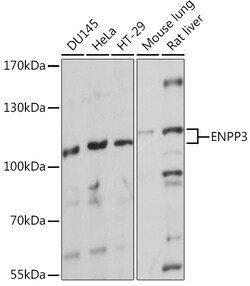
ABclonal Technology ENPP3 Rabbit pAb

The protein encoded by this gene belongs to a series of ectoenzymes that are involved in hydrolysis of extracellular nucleotides. These ectoenzymes possess ATPase and ATP pyrophosphatase activities and are type II transmembrane proteins. Expression of the related rat mRNA has been found in a subset of immature glial cells and in the alimentary tract. The corresponding rat protein has been detected in the pancreas, small intestine, colon, and liver. The human mRNA is expressed in glioma cells, prostate, and uterus. Expression of the human protein has been detected in uterus, basophils, and mast cells. Two transcript variants, one protein coding and the other non-protein coding, have been found for this gene.

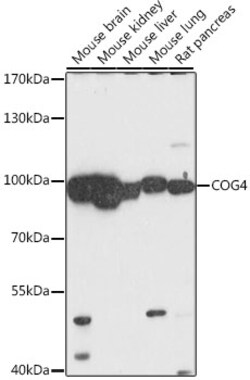
ABclonal Technology COG4 Rabbit pAb
The protein encoded by this gene is a component of an oligomeric protein complex involved in the structure and function of the Golgi apparatus. Defects in this gene may be a cause of congenital disorder of glycosylation type IIj. Two transcript variants encoding different isoforms have been found for this gene.
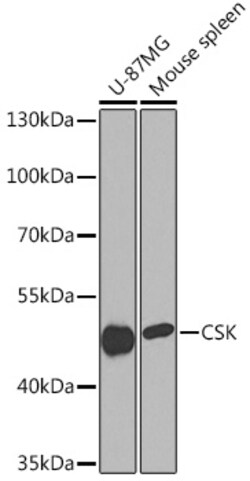
ABclonal Technology CSK Rabbit pAb
The protein encoded by this gene is involved in multiple pathways, including the regulation of Src family kinases. It plays an important role in T-cell activation through its association with the protein encoded by the protein tyrosine phosphatase, non-receptor type 22 (PTPN22) gene. This protein also phosphorylates C-terminal tyrosine residues on multiple substrates, including the protein encoded by the SRC proto-oncogene, non-receptor tyrosine kinase gene. Phosphorylation suppresses the kinase activity of the Src family tyrosine kinases. An intronic polymorphism (rs34933034) in this gene has been found to affect B-cell activation and is associated with systemic lupus erythematosus (SLE). Alternative splicing results in multiple transcript variants.
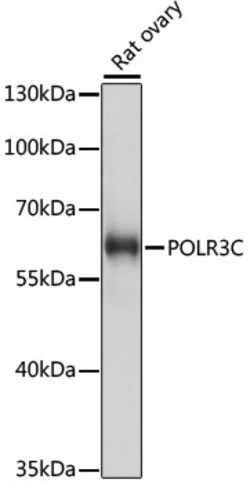
ABclonal Technology POLR3C Rabbit pAb
Enables single-stranded DNA binding activity. Involved in positive regulation of innate immune response and positive regulation of interferon-beta production. Located in nucleoplasm. Part of RNA polymerase III complex.
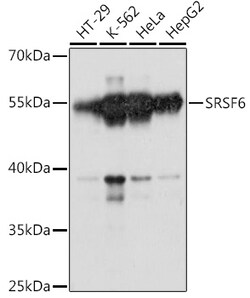
ABclonal Technology SRSF6 Rabbit pAb
The protein encoded by this gene is involved in mRNA splicing and may play a role in the determination of alternative splicing. The encoded nuclear protein belongs to the splicing factor SR family and has been shown to bind with and modulate another member of the family, SFRS12. Alternative splicing results in multiple transcript variants. In addition, two pseudogenes, one on chromosome 17 and the other on the X chromosome, have been found for this gene.
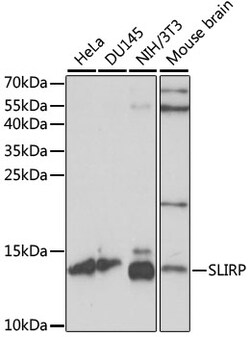
ABclonal Technology SLIRP Rabbit pAb
Steroid receptor RNA activator (SRA, or SRA1, MIM 603819) is a complex RNA molecule containing multiple stable stem-loop structures that functions in coactivation of nuclear receptors. SLIRP interacts with stem-loop structure-7 of SRA (STR7) and modulates nuclear receptor transactivation (Hatchell et al., 2006 [PubMed 16762838]).
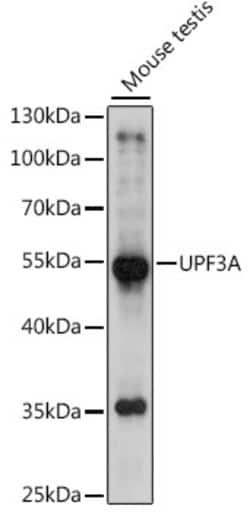
ABclonal Technology UPF3A Rabbit pAb
This gene encodes a protein that is part of a post-splicing multiprotein complex involved in both mRNA nuclear export and mRNA surveillance. The encoded protein is one of two functional homologs to yeast Upf3p. mRNA surveillance detects exported mRNAs with truncated open reading frames and initiates nonsense-mediated mRNA decay (NMD). When translation ends upstream from the last exon-exon junction, this triggers NMD to degrade mRNAs containing premature stop codons. This protein binds to the mRNA and remains bound after nuclear export, acting as a nucleocytoplasmic shuttling protein. It forms with Y14 a complex that binds specifically 20 nt upstream of exon-exon junctions. This gene is located on the long arm of chromosome 13. Several splice variants encoding different isoforms have been found for this gene.
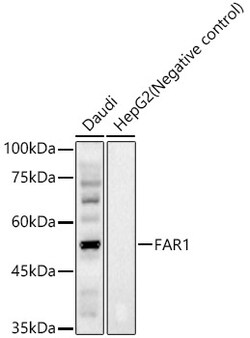
ABclonal Technology FAR1 Rabbit pAb
The protein encoded by this gene is required for the reduction of fatty acids to fatty alcohols, a process that is required for the synthesis of monoesters and ether lipids. NADPH is required as a cofactor in this reaction, and 16-18 carbon saturated and unsaturated fatty acids are the preferred substrate. This is a peroxisomal membrane protein, and studies suggest that the N-terminus contains a large catalytic domain located on the outside of the peroxisome, while the C-terminus is exposed to the matrix of the peroxisome. Studies indicate that the regulation of this protein is dependent on plasmalogen levels. Mutations in this gene have been associated with individuals affected by severe intellectual disability, early-onset epilepsy, microcephaly, congenital cataracts, growth retardation, and spasticity (PMID 25439727). A pseudogene of this gene is located on chromosome 13.
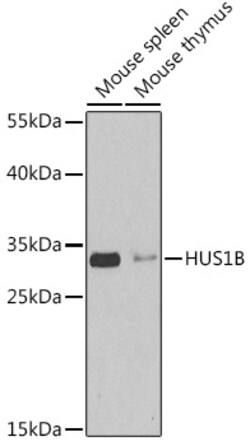
ABclonal Technology HUS1B Rabbit pAb
The protein encoded by this gene is most closely related to HUS1, a component of a cell cycle checkpoint protein complex involved in cell cycle arrest in response to DNA damage. This protein can interact with the check point protein RAD1 but not with RAD9. Overexpression of this protein has been shown to induce cell death, which suggests a related but distinct role of this protein, as compared to the HUS1.
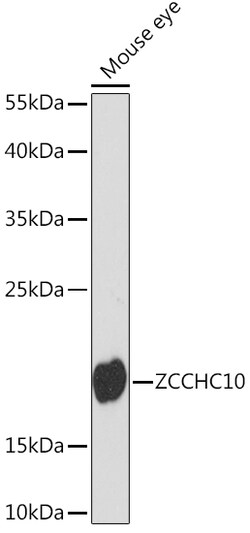
ABclonal Technology ZCCHC10 Rabbit pAb
Predicted to enable nucleic acid binding activity and zinc ion binding activity.
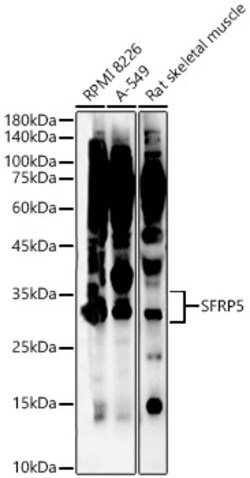
ABclonal Technology SFRP5 Rabbit pAb
Secreted frizzled-related protein 5 (SFRP5) is a member of the SFRP family that contains a cysteine-rich domain homologous to the putative Wnt-binding site of Frizzled proteins. SFRPs act as soluble modulators of Wnt signaling. SFRP5 and SFRP1 may be involved in determining the polarity of photoreceptor cells in the retina. SFRP5 is highly expressed in the retinal pigment epithelium, and moderately expressed in the pancreas.
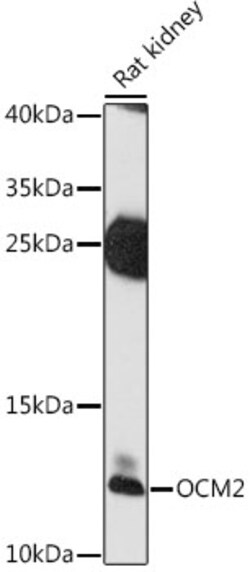
ABclonal Technology OCM2 Rabbit pAb
This gene is similar to the oncomodulin gene, a high-affinity calcium ion-binding protein that belongs to the superfamily of calmodulin proteins, also known as the EF-hand proteins.
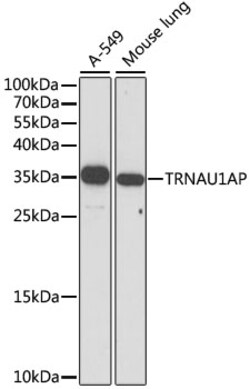
ABclonal Technology TRNAU1AP Rabbit pAb
Enables RNA binding activity. Predicted to be involved in selenocysteine incorporation. Predicted to be located in cytoplasm. Predicted to be active in nucleus.

Biotium CD44v9 (Marker of Tumor Metastasis) (rCD44v9/1459), CF594 conjugate, 0.1mg/mL
This antibody recognizes an epitope encoded by exon v4 on the variant portion of human CD44. The CD44 molecule belongs to a family of cellular adhesion molecules found on a wide range of normal and malignant cells in epithelial, mesothelial and hemopoiesis tissues. CD44 is a single gene with 20 exons, of which 10 are normally expressed to encode the basic CD44 (H-CAM) molecule. The additional 10 exons (v1 to v10) are only expressed by alternative splicing of the nuclear RNA. The expression of specific cell adhesion molecule CD44 splice variants has been reported to be associated with metastasis in certain human malignancies.Primary antibodies are available purified, or with a selection of fluorescent CF Dyes and other labels. CF Dyes offer exceptional brightness and photostability. Note: Conjugates of blue fluorescent dyes like CF405S and CF405M are not recommended for detecting low abundance targets, because blue dyes have lower fluorescence and can give higher non-specific
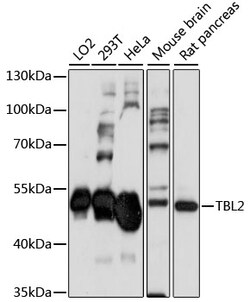
ABclonal Technology TBL2 Rabbit pAb
This gene encodes a member of the beta-transducin protein family. Most proteins of the beta-transducin family are involved in regulatory functions. This protein is possibly involved in some intracellular signaling pathway. This gene is deleted in Williams-Beuren syndrome, a developmental disorder caused by deletion of multiple genes at 7q11.23.